
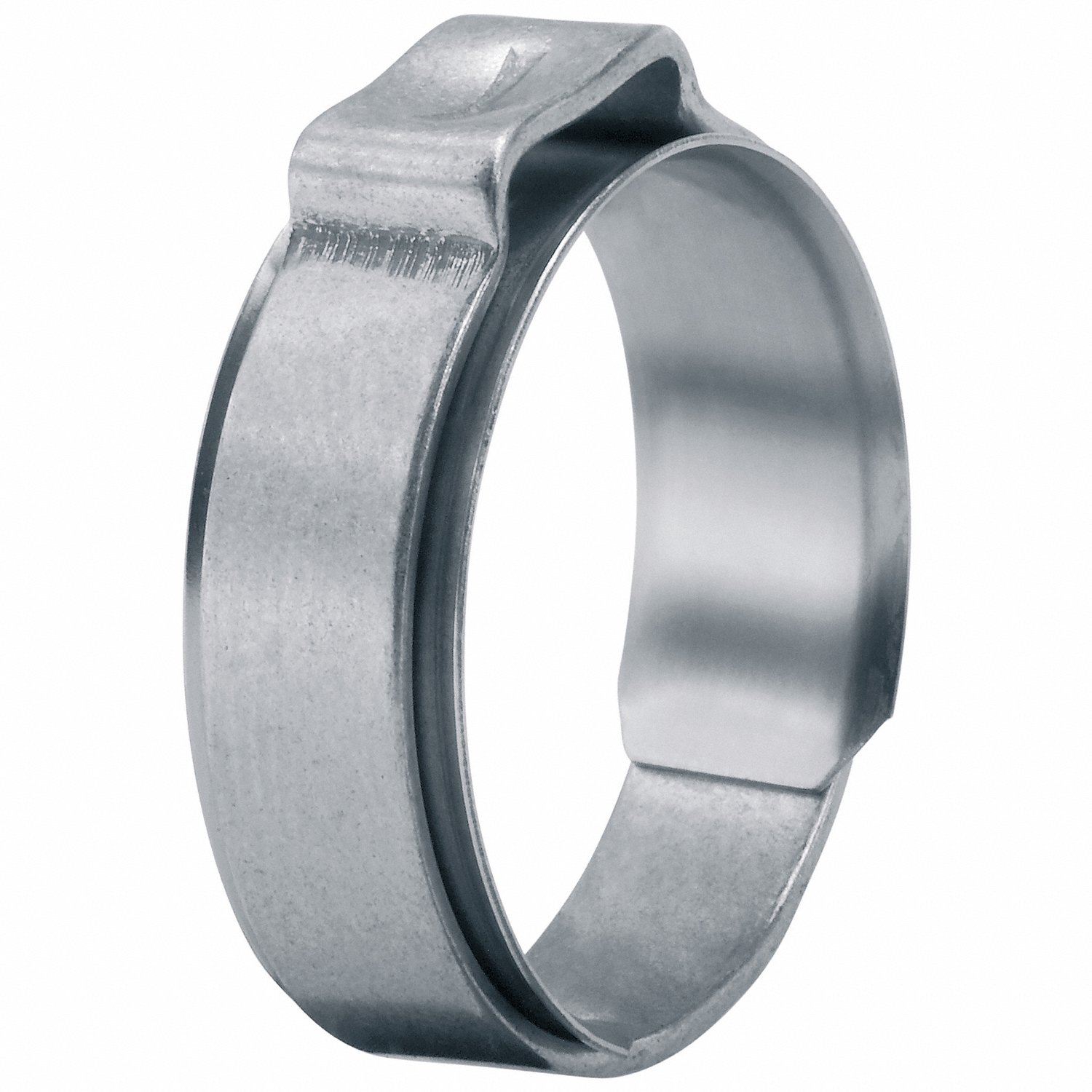
154 Series 1 Ear Clamps With Insert
OETIKER
| Size Range | Band Width | Type | Band Material | Pkg. Qty. | Price (inc. GST) |
|---|---|---|---|---|---|
| 2.5 mm to 2.9 mm | 0.27" | One Ear | - | 1 | RFQ |
| 2.7 mm to 3.1 mm | 0.27" | One Ear | - | 1 | RFQ |
| 2.9 mm to 3.7 mm | 0.27" | One Ear | - | 100 | SGD 200.16 |
| 3.3 mm to 4.2 mm | 0.27" | One Ear | - | 1 | RFQ |
| 3.3 mm to 4.2 mm | 0.27" | One Ear | Stainless Steel | 100 | RFQ |
| 3.7 mm to 4.7 mm | 0.27" | One Ear | - | 1 | RFQ |
| 4.2 mm to 5.2 mm | 0.27" | One Ear | Stainless Steel | 100 | RFQ |
| 4.2 mm to 5.2 mm | 0.27" | One Ear | - | 100 | SGD 109.35 |
| 4.7 mm to 5.7 mm | 0.27" | One Ear | - | 100 | SGD 107.31 |
| 5.2 mm to 6.2 mm | 0.27" | One Ear | - | 1 | RFQ |
| 5.6 mm to 6.5 mm | 0.27" | One Ear | - | 100 | SGD 96.97 |
| 5.9 mm to 7 mm | 0.27" | One Ear | - | 100 | SGD 84.59 |
| 6.3 mm to 7.5 mm | 0.27" | One Ear | - | 1 | RFQ |
| 6.6 mm to 7.8 mm | 0.27" | One Ear | - | 1 | RFQ |
| 7 mm to 8.2 mm | 0.27" | One Ear | - | 1 | RFQ |
| 7 mm to 8.5 mm | 0.27" | One Ear | - | 1 | RFQ |
| 8 mm to 9.5 mm | 0.27" | - | - | 1 | RFQ |
| 8.5 mm to 10 mm | 0.27" | One Ear | - | 1 | RFQ |
| 8.8 mm to 10.5 mm | 0.27" | One Ear | - | 1 | RFQ |
| 9.1 mm to 10.8 mm | 0.27" | One Ear | - | 1 | RFQ |
| 9.5 mm to 11.5 mm | 0.27" | One Ear | - | 100 | SGD 94.91 |
| 9.6 mm to 11.3 mm | 0.27" | One Ear | - | 100 | SGD 94.91 |
| 9.8 mm to 11.8 mm | 0.27" | One Ear | - | 1 | RFQ |
| 10.3 mm to 12.3 mm | 0.27" | One Ear | - | 100 | SGD 94.91 |
| 10.6 mm to 12.6 mm | 0.27" | One Ear | - | 1 | RFQ |
| 11.1 mm to 13.1 mm | 0.27" | One Ear | - | 1 | RFQ |
| 11.3 mm to 13.3 mm | 0.27" | One Ear | - | 1 | RFQ |
| 11.8 mm to 13.8 mm | 0.27" | One Ear | - | 1 | RFQ |
| 12.3 mm to 14.3 mm | 0.27" | One Ear | - | 100 | SGD 92.85 |
| 12.8 mm to 14.8 mm | 0.27" | One Ear | - | 100 | SGD 90.78 |
| 13.1 mm to 15.3 mm | 0.27" | One Ear | - | 100 | SGD 92.85 |
| 13.2 mm to 15.8 mm | 0.27" | One Ear | - | 1 | RFQ |
| 13.9 mm to 16.1 mm | 0.27" | One Ear | - | 1 | RFQ |
| 14.6 mm to 16.8 mm | 0.27" | One Ear | - | 1 | RFQ |
| - | 0.27" | One Ear | - | 100 | SGD 96.97 |
Description
Hose clamps with an insert (like Oetiker 154 Series stainless steel one ear clamps) are ideal for clamping hoses where a more secure hold is required, as compared to conventional clamps. These single ear clamps feature a thin walled insert ring to ensure ) are also available on Raptor Supplies.
Uses & Applications
Oetiker 154 Series single ear clamps are ideal for use with rubber hoses, plastic tubing, electrical cables and welding hoses.
Working Mechanism
How do you use Oetiker 154 Series single ear clamps?
- Oetiker 154 Series single ear clamps have a metal band with a protruding ear, the sides of which are forced together to tighten the ring around the hose.
- The metal band is fitted around the hose that needs to be connected. If you don't do this first, you won't be able to introduce the clamp from the other end of the hose once the hose is attached.
- When the clamp is on, the hose passes over the pipe or pipe fitting.
- To ensure a snug fit and no gaps once the clamp is secured, the inside diameter of the hose should be close to the outside diameter of the pipe.
- By using specialised pincers, the ear clamp tightens around the attached hose, forcing the sides together.
- The pincers are available in a standard style that closes the clamp by being held parallel to the ear, as well as a side jaw style that closes the clamp by being held perpendicular to the ear. Side jaw pincers can be used to access tight spaces that are difficult to reach with traditional pincers.
- It is important to crimp Oetiker clamps with a single tool stroke only. If you crimp them more, the clamps might become damaged.
Features
- Oetiker 154 Series single ear clamps come with a pre-shaped insert that delivers an effective, powerful & all round seal during installation.
- These ear clamps are integrated with a mechanical interlock to keep them closed over a hose.
- They have a single ear for exerting uniform compression.
- They feature a one piece design without any movable parts for tamper proof operation and robust & secure connections.
- Oetiker 154 Series single ear clamps feature surface technique treated edges for less risk of damage to the hose.
- These clamps are ideal for small diameters (3.3 mm) and offer fast and simple assembly.
- They feature a visible deformation that provides evidence of proper closure.
Standards & Approvals
Oetiker 154 Series single ear clamps are manufactured according to DIN EN ISO 9227 international standards for corrosion resistance and durability. They also meet ISO 9001:2015 and IATF 16949:2016 standards for ensuring environmental health and defect-free operation.
Frequently Asked Questions
It is important for customers to decide what type of ear clamp they need based on the application.
- In general, single ear clamps are used in thermally stable environments where the hose and clamp diameter are constant, whereas double ear clamps are ideal for environments where the hose diameter can fluctuate (increase or decrease) due to temperature change.
- Users should also choose ear clamps on the basis of their construction. These ear clamps are available in variants having galvanised or stainless steel construction. Zinc plated steel ear clamps have slightly lesser resistance to corrosion than stainless steel ear clamps.
- For selecting ear clamps of the correct size, customers should measure the outside diameter of the hose being used, and choose a clamp that has the measured hose diameter in the middle of its clamping range.
- Hose clamps come in diverse shapes, styles and sizes. However, the majority of them follow the same process for proper fitting on a hose, tube or pipe fitting. Once the hose is pressed securely onto the mating part, the hose clamp is positioned towards the end of the hose, with approximately 1/4 inch space between the clamp and the end of the hose.
- Selected models of Oetiker clamps, like universal & screw clamps, can be reused after removing them from hoses that do not require clamping.
- Screw clamps have an internal screw, bridge & D nut for tightening them around hoses using a screwdriver. Ear clamps use their single / double ear configuration to crimp a hose under constant jaw force.
- Raptor Supplies offers an extensive catalogue comprising Oetiker ear, screw, stepless ear, stepless screw & worm gear clamps. We also sell accessories such as straps, clamps, rings, connectors and assembly & disassembly tools from Oetiker.
- Single ear hose clamps do not require specific maintenance. However, it is important to periodically inspect them for signs of wear or corrosion and replace them if necessary to maintain a secure seal.
Explore More
- ALLANSON
- GOODYEAR ENGINEERED PRODUCTS
- KEYSHAFT
- DUSTLESS TECHNOLOGIES
- SAF-HOLLAND
- Cordless Cable Cutters
- Speed Reducers and Gear Drives
- Air Compressor Pumps
- Digital Calipers
- Wheel Torque Sockets
- NEWSTRIPE Roller And Disc Kits For Parking Lot Striping Machines
- OETIKER HIP 2000 Series Hand Installation Pincers
- TYGON E-3603 Tubings, Metric Size
- ANVIL AS679 Series U Supports
- LUMENITE CONTROL TECHNOLOGY INC. Liquid Level Probes
- TSUBAKI Sprocket 3.520
- EATON PowerXL DA1 Adjustable Frequency Drives
- PARLEC Retention Knobs